
Football Tipsters Compared by Gambling Nerd: Mark O’Haire vs Kevin Hatchard
Football Tipsters Compared by Gambling Nerd: Mark O’Haire vs Kevin Hatchard. Two experienced football analysts, both with accessible public tips. Gambling Nerd examines their backgrounds, market choices and reasoning, and what readers can reasonably learn from each.
Choosing between football tipsters involves more than finding a familiar name beside a winning selection. Mark O’Haire and Kevin Hatchard both explain their bets in public, making them useful subjects for Gambling Nerd’s comparison of how analysts turn football knowledge into a betting recommendation.
The most useful distinction is the kind of analysis a reader wants to examine. O’Haire’s reviewed work shows a willingness to look beyond match results into cards and corners. Hatchard’s reviewed preview connects team circumstances with goals and individual player markets. Both offer arguments readers can question; neither is established here as the more profitable tipster.
Who is Mark O’Haire
According to his Betfair author profile, O’Haire began in newspaper journalism and has more than 15 years of experience as a betting analyst and tipster. His coverage ranges from major international tournaments to Scandinavian summer leagues. He was also a founding contributor to Football… Only Bettor.
That breadth makes him a relevant prospect for readers interested in how an analyst selects a market, rather than simply which team he expects to win. The reviewed column offers specific examples of that approach. It should not, however, be treated as a description of every bet he publishes.
Who is Kevin Hatchard
Hatchard’s Betfair biography describes 25 years in sports journalism and more than 15 years writing for the betting platform. His specialism is European football, with commentary work for talkSPORT, UEFA and the Bundesliga, alongside appearances on Sky Sports News.
His background makes him a natural comparison for O’Haire: both combine football reporting with betting analysis, but readers can examine how each develops a recommendation. Broadcasting credentials establish experience and familiarity with the game. They do not, by themselves, establish profitable betting performance.
How their football betting analysis differs
In O’Haire’s Premier League final-day column, updated on 24 May 2026, his selections included low card totals and a Tottenham corners-and-cards combination. The arguments considered referee tendencies, team statistics and the circumstances surrounding the fixtures.
For the Tottenham selection, he moved away from the match-result market and combined over 5.5 team corners with over 2.5 team cards. The useful lesson for readers is that an opinion about a match can lead to several possible markets. The task is to judge whether the evidence supports the particular thresholds and price selected.
Hatchard’s Wales versus Portugal preview, published on 17 November 2026, discussed expected goals, finishing, defensive results and squad absences. His recommended bet combined both teams to score with a shot on target from João Félix and Bruno Fernandes, quoted at decimal odds of 2.80.
That example brings individual players into the match assessment. A reader must consider likely involvement and opportunities as well as the wider scoring argument. The presence of several plausible components does not automatically make their combined price attractive.
These examples show overlap as well as differences. Both analysts use statistics and football context, and both can recommend combinations. It would be misleading to label one purely statistical and the other purely intuitive on this evidence.
Are their football tips free or paid
The Betfair articles reviewed by GamblingNerd.com for this comparison were publicly readable without purchasing a tipster subscription. Readers can therefore inspect these examples of both analysts’ work before deciding whether to follow their selections.
This comparison concerns those public articles. It does not assess any separate private service or imply that every product associated with either analyst is free. The articles also appear on a bookmaker’s publishing platform, a commercial context readers should distinguish from an independent record of betting returns.
Why the odds matter as much as the prediction
Gambling Nerd’s guide to expected value in sports betting in The Nerd Nook Hub explains the underlying issue: a bet’s theoretical value depends on its probability and price. A convincing prediction can still be poor value at unsuitable odds.
Consider a hypothetical selection with an estimated 50% chance of winning. At decimal odds of 2.10, a £10 stake has a theoretical expected profit of 50p. At 1.90, the same probability estimate produces an expected loss of 50p. Those calculations assume the estimate is accurate and exclude any additional charges; they do not forecast an individual result.
This is why a follower should record the price available when reading a tip. A recommendation at 2.80 cannot be evaluated as though it were unchanged if the available odds have fallen to 2.40. A better match narrative does not compensate automatically for a worse price.
What would establish a fair performance comparison
The biographies and examples reviewed do not establish a complete, independently verified, like-for-like performance record for the two analysts. Selecting a few winning previews would provide an unreliable basis for declaring a winner.
A meaningful comparison would track every selection in a defined series over the same period. It would preserve original publication times, advised odds, stakes, settlements and subsequent edits. Returns should be calculated consistently, with any exchange commission included where applicable.
Selections in an individual author’s column should also remain separate from other contributors’ bets and from any collective podcast record. For combinations, the published wager needs its own settlement: two successful legs in a losing treble do not create a winning bet.
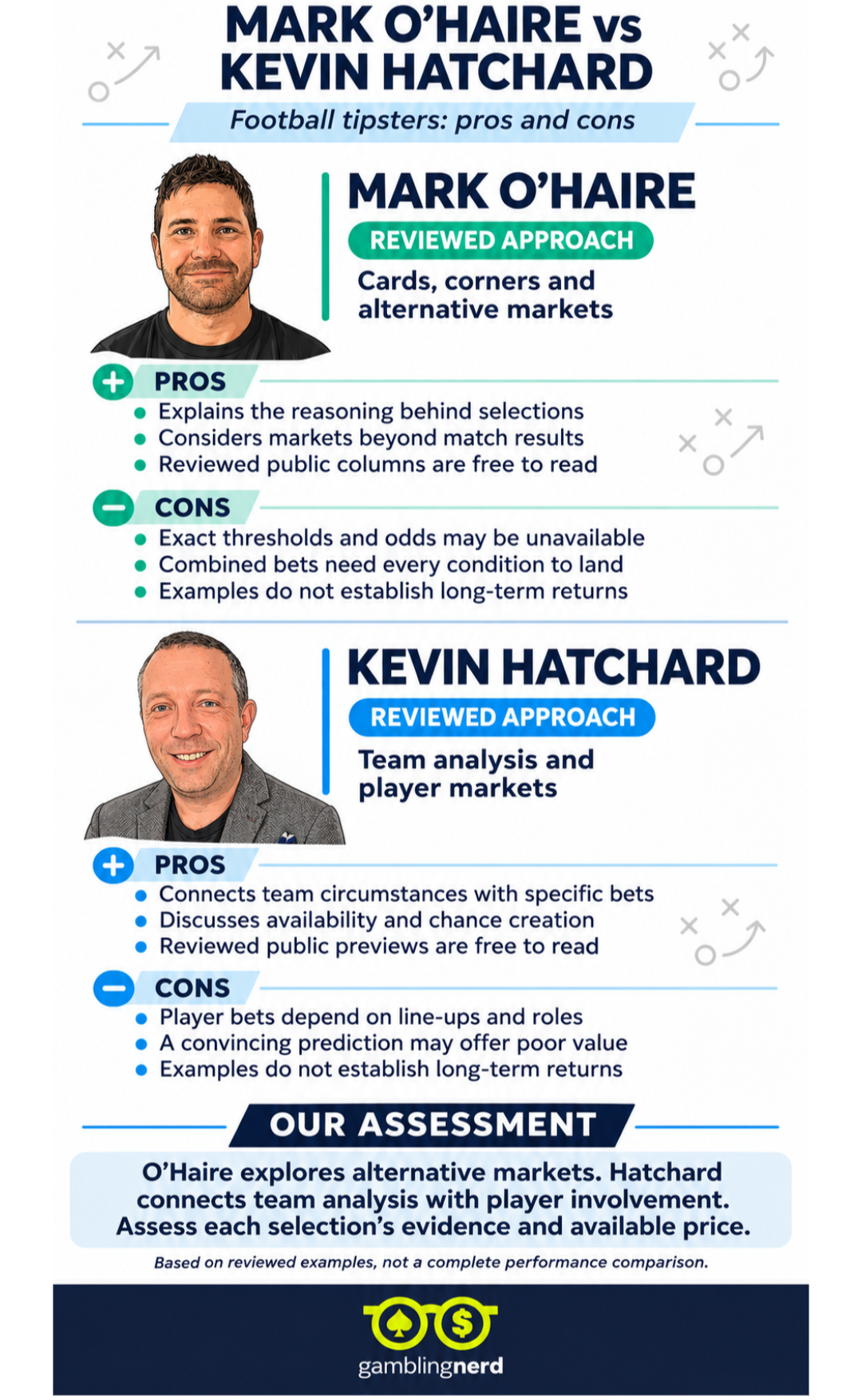
Mark O’Haire pros and cons
O’Haire’s reviewed column is useful for readers who want to explore alternative football markets. Its strengths include an identifiable author, explicit selections and explanations connecting match circumstances to cards and corners.
The limitations follow from those markets. Readers need to check the precise thresholds, prices and settlement rules available on their own accounts. Some recommendations also require a combined outcome. This sample supports an assessment of his reasoning, rather than a claim about his long-term returns.
Kevin Hatchard pros and cons
Hatchard offers a detailed route from team assessment to a specific selection. His reviewed preview gives readers several assumptions to examine, including chance creation, availability, and the players expected to contribute.
The corresponding limitation is that a player-based combination depends on more than the broad match prediction. Changes to the starting line-up or a player’s role may weaken the argument. Familiarity with a league remains useful context, but the reader still needs to assess the wager and its price.
Which football tipster should readers follow
For someone interested in cards, corners and the choice between alternative markets, O’Haire’s reviewed work is a useful starting point. For someone who prefers a match preview connecting team circumstances with player involvement, Hatchard’s reviewed analysis offers a clear example.
Readers need not choose one permanently. Comparing their reasoning on the same competition can reveal which assumptions matter, where evidence is thin and when the available odds no longer support a selection. Agreement between two analysts should not be treated as two independent confirmations if both rely on the same information.
The practical verdict is to assess the particular recommendation, its evidence and its price. Both are worth examining as football analysts. A claim that either is the better betting performer would require a fuller and comparable results record.
About Gambling Nerd
Gambling Nerd publishes guides and analysis on sports betting, casino games and gambling mathematics. Its educational resource, The Nerd Nook Hub, explores concepts such as expected value, implied probability and closing line value, helping readers assess betting claims and understand the relationship between odds, strategy and risk.

Data engineers and football analysts building transparent, model-driven predictions. Every tip we publish is settled publicly on our track record — read more about us and our editorial policy.

